The Growing Challenge of Feeding a Changing World
Food has always been at the center of human civilization.
From the earliest farming communities to modern agricultural systems, the ability to produce enough food has determined the growth of societies, cities, and nations. For thousands of years, people relied on traditional farming methods to cultivate crops and raise livestock.
As populations increased, agriculture evolved.
Farmers developed better tools, improved irrigation systems, created fertilizers, and introduced advanced machinery. These innovations helped produce larger harvests and support billions of people around the world.
Yet new challenges continue to emerge.
The global population continues to grow, increasing the demand for food every year. At the same time, farmers face difficulties such as climate change, water shortages, soil degradation, plant diseases, and limited agricultural land.
Producing meat presents additional challenges.
Livestock farming requires large amounts of land, water, feed, and energy. As demand for meat increases worldwide, researchers have begun exploring ways to produce food more efficiently and sustainably.
This search for solutions has led scientists toward biotechnology.
Biotechnology involves using living organisms, biological systems, and advanced scientific techniques to develop products and solve practical problems. In agriculture and food production, biotechnology has already helped improve crop yields, disease resistance, and food quality.
More recently, researchers have begun exploring something even more revolutionary.
What if meat could be produced without raising and slaughtering entire animals?
What if milk, eggs, and other foods could be created using biological processes in controlled environments?
What if future food production relied partly on laboratories alongside farms?
These questions have given rise to the rapidly developing field of lab-grown food.
Also known as cultivated food, cultured food, or cell-based food, lab-grown food represents one of the most ambitious attempts to transform the global food system.
Supporters believe it could help address environmental challenges, improve food security, and reduce pressure on natural resources. Critics argue that significant technical, economic, and social questions still need answers.
Regardless of the outcome, biotechnology and lab-grown food are becoming increasingly important topics in discussions about the future of agriculture and global food production.
How Biotechnology and Lab-Grown Food Actually Work
When people hear the term “lab-grown food,” many imagine artificial products created entirely from chemicals.
The reality is quite different.
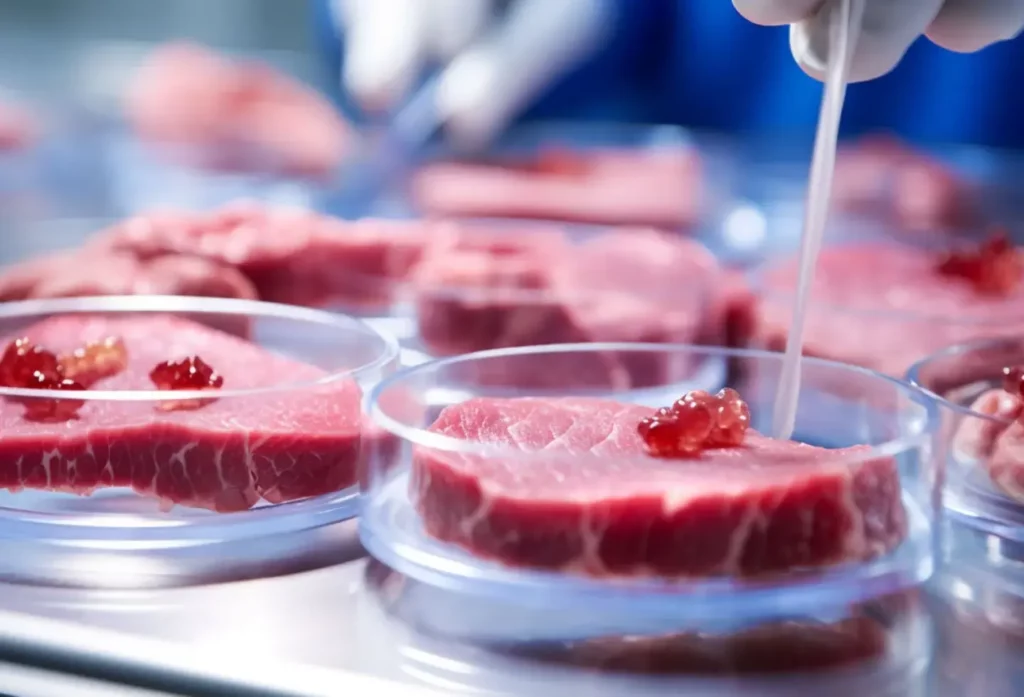
Most cultivated meat begins with real animal cells.
Scientists obtain a small sample of cells from a living animal. These cells are then placed in carefully controlled environments where they receive nutrients, oxygen, and conditions that allow them to grow and multiply.
Over time, the cells develop into muscle