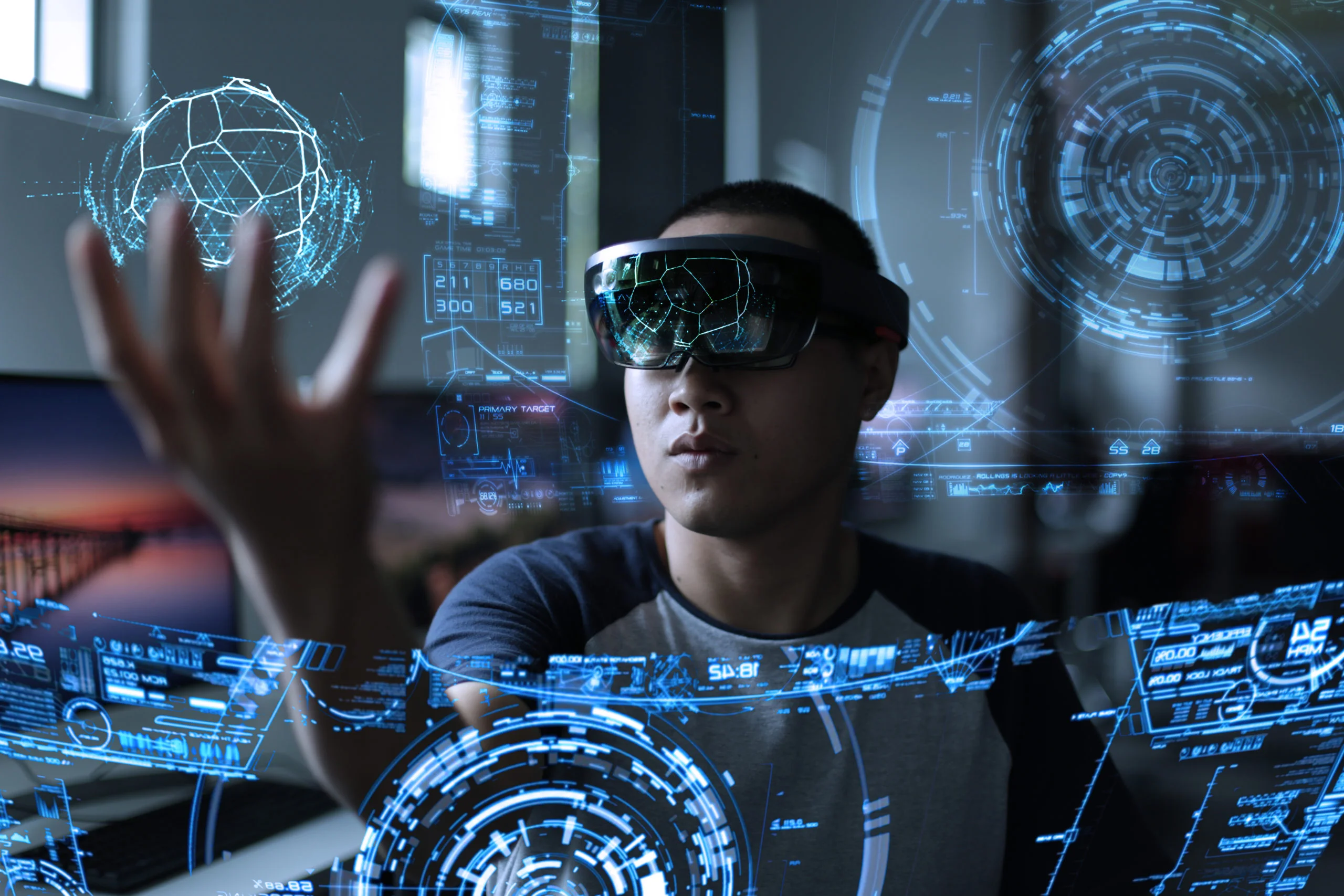
From Computer Screens to Immersive Digital Experiences
For most of the history of computing, people interacted with technology through screens. Whether it was a desktop monitor, television, laptop, tablet, or smartphone, digital experiences were usually confined to a rectangular display.
People looked at information through a window rather than feeling part of it.
As computers became more powerful, developers created increasingly realistic graphics, interactive applications, and sophisticated games. Yet there was still a clear separation between the digital world and the physical world.
A person remained outside the experience, looking in.
Scientists, engineers, and technology companies began imagining a different future.
What if people could step inside digital environments instead of simply viewing them?
What if computer-generated objects could appear in the real world?
What if physical and digital experiences could merge so naturally that the boundary between them became difficult to notice?
These questions led to the development of technologies that are now grouped under a broader term known as Extended Reality, or XR.
Extended Reality is an umbrella term that includes Virtual Reality (VR), Augmented Reality (AR), and Mixed Reality (MR). Although each technology works differently, they all aim to change how people interact with digital information and environments.
Virtual Reality creates fully immersive digital worlds.
Augmented Reality adds digital elements to the real world.
Mixed Reality allows digital and physical objects to interact with one another in more advanced ways.
Together, these technologies are transforming how people learn, work, communicate, shop, play, and explore information.
What once seemed like science fiction is gradually becoming part of everyday life.
Headsets are becoming lighter and more powerful. Mobile devices are gaining advanced sensing capabilities. Artificial Intelligence is helping systems understand environments more accurately.
As a result, XR is moving beyond gaming and entertainment into education, healthcare, business, manufacturing, engineering, and countless other fields.
The shift may eventually be as significant as the transition from desktop computers to smartphones.
Understanding Virtual Reality, Augmented Reality, and Mixed Reality
Although XR is often discussed as a single concept, it actually includes several different technologies.
Virtual Reality, commonly known as VR, creates a completely digital environment.
When a person wears a VR headset, the real world is largely blocked from view. Instead, the user enters a computer-generated environment that can look like a classroom, a game world, a factory, a historical location, or even another planet.
As the user moves their head and body, the virtual environment responds accordingly, creating the feeling of being present inside that digital space.
Virtual Reality is often used for gaming, simulations, training, and immersive experiences.
Augmented Reality, or AR, works differently.
Instead of replacing the real world, AR adds digital information on top of it. A smartphone camera or special glasses can display digital objects, directions, labels, animations, or information while the user continues to see their physical surroundings.
Many people have already experienced simple forms of Augmented Reality through smartphone applications that place digital characters, furniture, or visual effects into real-world environments.
Mixed Reality, often abbreviated as MR, takes the concept even further.
In Mixed Reality, digital objects not only appear in the physical world but also interact with it. Virtual items can remain fixed in specific locations, respond to physical surfaces, and behave as though they truly exist within the environment.
Imagine wearing smart glasses and seeing a virtual computer screen floating above your desk. You could move around it, resize it, and interact with it as though it were a physical object.
Artificial Intelligence plays a major role in making these experiences possible.
XR systems use cameras, sensors, depth scanners, and machine learning algorithms to understand the surrounding environment. They identify walls, floors, furniture, people, and objects, allowing digital content to blend more naturally with reality.
Advances in graphics processing, wireless communication, cloud computing, and battery technology are also helping XR devices become more practical and accessible.
As these technologies improve, digital experiences are becoming increasingly immersive, realistic, and useful.
How XR Could Transform Education, Healthcare, and Daily Life
One of the reasons XR attracts so much attention is its potential to change far more than entertainment.
Education may become one of the biggest beneficiaries.
Traditional learning often depends on textbooks, diagrams, videos, and lectures. While these methods can be effective, some concepts are difficult to visualize.
Imagine a student learning about ancient civilizations by virtually walking through historical cities. A biology student could explore the human body from the inside. An engineering student could interact with complex machinery in three-dimensional space.
XR has the potential to make learning more interactive, engaging, and memorable.
Healthcare is another field experiencing rapid innovation.
Medical students can practice surgical procedures in virtual environments before working with real patients. Surgeons may use Augmented Reality to view critical information during operations. Patients undergoing rehabilitation can participate in immersive therapy programs designed to improve recovery outcomes.
Mental health professionals are also exploring Virtual Reality for treating certain phobias, anxiety disorders, and post-traumatic stress conditions.
Businesses are discovering new applications as well.
Remote work has become increasingly common, but video calls still have limitations. XR technologies may allow colleagues from different countries to collaborate inside shared virtual workspaces where they can interact with digital models, presentations, and data as though they were in the same room.
Manufacturing and industrial operations can benefit too.
Workers may use smart glasses that display instructions directly within their field of view. Technicians can receive step-by-step guidance while repairing equipment. Engineers can visualize designs at full scale before construction begins.
Shopping experiences may also change dramatically.
Customers could virtually try on clothing, preview furniture inside their homes, or explore products in three-dimensional environments before making purchases.
Tourism and travel industries are experimenting with immersive experiences that allow people to explore destinations virtually before visiting in person.
Even everyday activities could evolve.
Future XR glasses may provide navigation directions while walking through a city, display real-time translations during conversations, or show useful information about nearby locations and objects.
As devices become smaller, lighter, and more affordable, XR may gradually become integrated into many aspects of daily life.
The Challenges, Opportunities, and Future of XR
Despite its promise, Extended Reality still faces several challenges.
One of the biggest obstacles is hardware.
Current XR headsets can be bulky, expensive, and sometimes uncomfortable during extended use. Manufacturers are working to create lighter devices that look more like ordinary glasses while maintaining powerful capabilities.
Battery life remains another challenge.
Advanced graphics, sensors, cameras, and wireless connectivity require significant power. Improving battery technology will be essential for making XR devices practical for all-day use.
Cost is also an important factor.
Although prices have decreased over time, many advanced XR systems remain expensive for average consumers. Wider adoption will likely depend on continued reductions in manufacturing costs.
Motion sickness and user comfort continue to be areas of active research.
Some users experience discomfort when virtual environments do not perfectly match physical movements. Engineers are developing faster displays, improved tracking systems, and better software to address these issues.
Privacy concerns are becoming increasingly important as well.
XR devices often use cameras, microphones, location tracking, and environmental scanning to function effectively. Protecting user data and ensuring responsible use of these technologies will remain critical.
Content creation presents another challenge.
Building high-quality XR experiences requires specialized skills in design, programming, animation, and three-dimensional modeling. As tools improve, creating immersive content is expected to become easier and more accessible.
Despite these obstacles, investment in XR continues to grow rapidly.
Technology companies, educational institutions, healthcare organizations, and industrial businesses are exploring new applications every year. Advances in Artificial Intelligence, cloud computing, and high-speed wireless networks are accelerating progress.
Many experts believe XR may eventually become the next major computing platform.
Just as smartphones transformed communication and internet access, XR devices may transform how people interact with digital information. Instead of looking down at screens, users may interact with digital content that surrounds them naturally throughout the day.
Future generations may find it normal to attend virtual meetings, learn through immersive simulations, shop in mixed-reality environments, and communicate using digital spaces that feel almost as real as physical ones.
The digital and physical worlds have long existed separately. Extended Reality is gradually bringing them together. By combining Virtual Reality, Augmented Reality, and Mixed Reality into increasingly seamless experiences, XR is creating new ways for people to learn, work, create, and connect.
The technology is still evolving, but its potential is enormous. As hardware improves and applications expand, Extended Reality may become one of the defining technologies of the twenty-first century, changing not only how people use computers but also how they experience reality itself.