Understanding the Hidden Language Inside Every Living Thing
For thousands of years, people observed how traits passed from one generation to another. Farmers noticed that certain crops produced better harvests. Animal breeders discovered that specific characteristics could appear repeatedly in future generations. Parents often saw similarities between themselves and their children.
Yet no one truly understood why these patterns occurred.
The answer remained hidden deep inside every living cell.
During the twentieth century, scientists made one of the most important discoveries in human history. They uncovered the structure and function of DNA, the molecule that carries genetic information.
DNA acts like an instruction manual for life.
Every living organism, from tiny bacteria to giant whales, contains DNA. Inside this remarkable molecule are the instructions that help determine how organisms grow, develop, function, and reproduce.
The information is organized into units called genes.
Genes influence countless characteristics. They help determine eye color, height, blood type, plant growth, disease resistance, and thousands of other biological traits. In many ways, genes serve as the biological blueprint that guides life itself.
For decades, scientists could study genes, identify them, and learn how they worked. However, changing them was much more difficult.
Researchers often compared the challenge to trying to edit a book without being able to locate specific words or sentences. They could read parts of the genetic code, but making precise changes was extremely challenging.
As technology advanced, scientists developed new tools that allowed them to understand DNA in greater detail. They learned how genes interact with one another and how genetic variations influence health, development, and disease.
This growing knowledge led to an extraordinary question.
What if scientists could not only read genetic information but also edit it?
What if harmful genetic mutations could be corrected?
What if crops could be made more resistant to drought?
What if diseases could be treated by changing faulty genes directly?
These questions gave rise to two closely related fields known as gene editing and genetic engineering.
Gene editing focuses on making precise changes to DNA. Genetic engineering involves modifying the genetic material of organisms to achieve specific goals.
Together, these technologies are opening possibilities that previous generations could barely imagine.
How Scientists Edit the Blueprint of Life
To understand gene editing, imagine a massive encyclopedia containing billions of letters.
Now imagine trying to find a single spelling mistake hidden somewhere within those pages.
For many years, locating and correcting specific sections of DNA was extremely difficult. Scientists needed a method that could identify precise locations within the genetic code and make targeted changes.
One of the most important breakthroughs came with the development of gene-editing tools such as CRISPR Gene Editing.
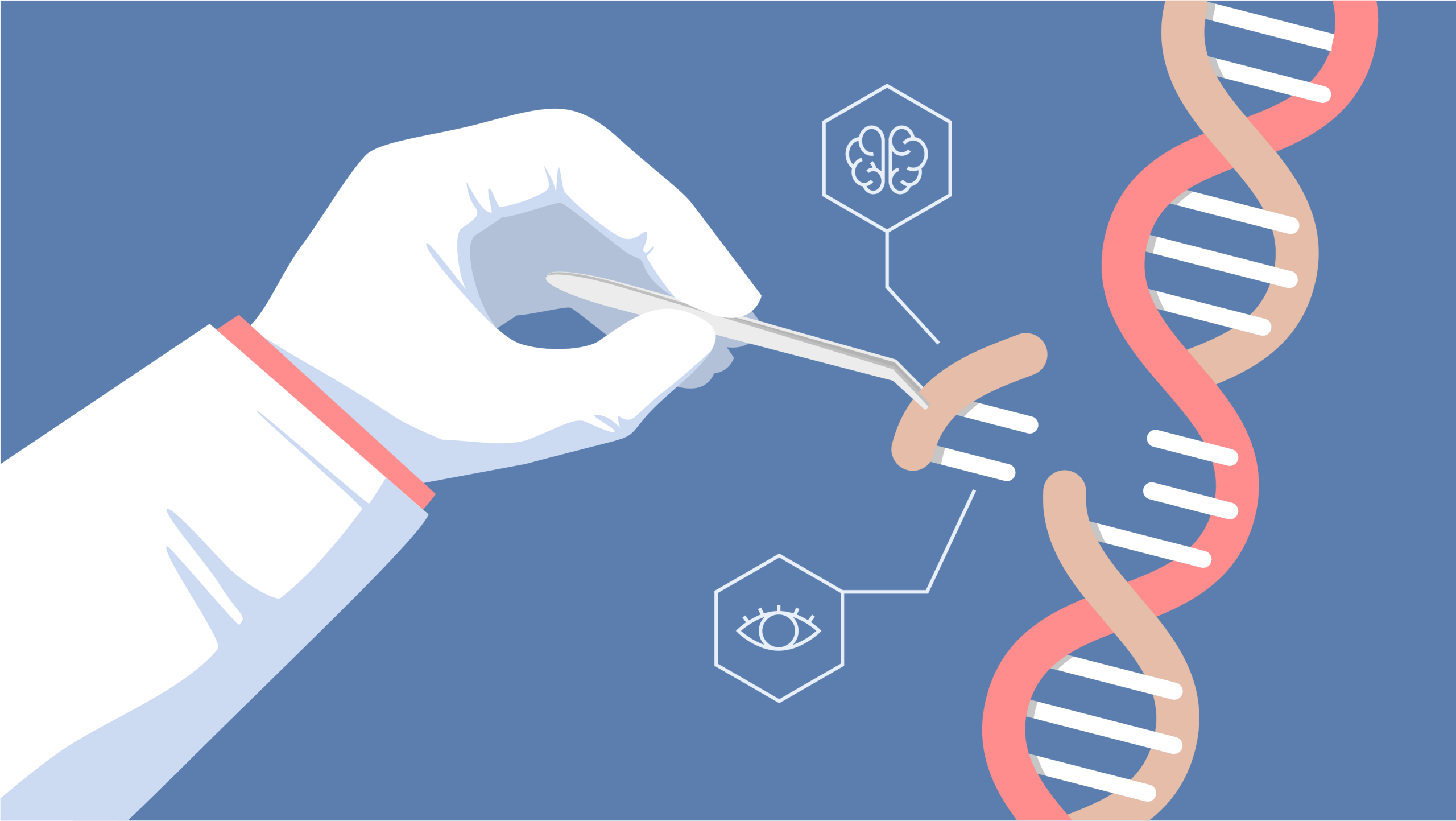
CRISPR is often compared to a pair of molecular scissors.
It allows researchers to locate specific sections of DNA and make highly precise modifications. Scientists can remove unwanted genetic material, replace certain sequences, or introduce new genetic instructions.
The process is remarkably sophisticated.
First, researchers identify the target gene they want to modify. They then design molecular guides that direct the editing system to the correct location within the DNA.
Once the target is reached, the gene-editing tool cuts the DNA at the chosen point. The cell’s natural repair mechanisms then help complete the modification process.
This level of precision was once considered impossible.
Modern gene-editing technologies can often make changes with extraordinary accuracy, allowing scientists to address genetic problems that previously had no practical solutions.
Genetic engineering goes beyond editing individual genes.
Scientists can introduce new genetic traits into plants, animals, and microorganisms. In agriculture, this may involve creating crops that resist pests, tolerate drought, or produce higher yields.
In medicine, researchers can modify cells to help fight diseases or improve treatment outcomes.
Artificial Intelligence is increasingly assisting these efforts by analyzing massive genetic datasets and identifying patterns that humans might overlook. Advanced computing allows researchers to study complex interactions between genes and predict the effects of specific modifications.
DNA sequencing technology has also become faster and more affordable.
The first complete human genome required years of work and billions of dollars to decode. Today, genetic analysis can often be performed far more quickly and at a fraction of the cost.
As these technologies continue to improve, scientists are gaining an unprecedented ability to understand and modify the fundamental instructions that govern life.
How Gene Editing Could Transform Medicine, Agriculture, and Society
The potential applications of gene editing are among the most exciting developments in modern science.
Perhaps the greatest impact may occur in healthcare.
Many diseases are linked to genetic mutations. Some individuals inherit faulty genes that increase the risk of serious illnesses or cause medical conditions from birth.
Traditional treatments often focus on managing symptoms. Gene editing offers a different possibility.
Instead of treating the effects of a disease, scientists may be able to correct the underlying genetic cause.
Researchers are already exploring treatments for inherited blood disorders, certain forms of blindness, immune system diseases, and other genetic conditions. In some cases, experimental therapies have produced encouraging results.
Cancer treatment is another area receiving significant attention.
Scientists are developing methods that modify a patient’s immune cells to better recognize and attack cancer cells. These approaches represent a new generation of personalized medicine.
Agriculture may experience equally significant changes.
Farmers face challenges such as drought, extreme weather, pests, plant diseases, and growing food demand. Gene-edited crops may help address many of these issues.
Scientists are working on plants that require less water, resist diseases more effectively, and produce improved nutritional value. Such innovations could contribute to food security in regions facing environmental challenges.
Livestock breeding may also benefit.
Researchers are studying ways to improve animal health, disease resistance, and productivity while reducing environmental impacts.
Environmental conservation presents additional possibilities.
Scientists are exploring whether genetic technologies could help protect endangered species, restore damaged ecosystems, or combat invasive organisms that threaten biodiversity.
Industrial biotechnology is another growing field.
Genetically engineered microorganisms can produce medicines, enzymes, biofuels, and other valuable products more efficiently than traditional manufacturing methods.
The economic implications are substantial as well.
Entire industries are emerging around genetic research, biotechnology, precision medicine, agricultural innovation, and bioengineering. These sectors are creating new jobs, attracting investment, and driving scientific advancement.
As the technology matures, gene editing may become one of the most influential tools available for solving some of humanity’s most complex biological challenges.
The Ethical Questions, Risks, and Future of Genetic Engineering
Despite its promise, gene editing raises important ethical, scientific, and social questions.
One concern involves unintended consequences.
Genes rarely operate in isolation. A change made to one part of the genetic code may influence other biological processes in ways that are not immediately obvious. Researchers must carefully study potential risks before applying genetic modifications widely.
Safety remains a top priority.
Although gene-editing tools have become increasingly precise, mistakes can still occur. Scientists continue working to improve accuracy and reduce the possibility of unintended changes.
Ethical debates become even more complex when discussions move beyond treating diseases.
Most people support efforts to cure serious genetic disorders. However, questions arise when considering potential enhancements.
Should genetic technologies be used to improve physical abilities, intelligence, appearance, or other traits in healthy individuals?
Could such modifications create new forms of inequality?
Who should decide which genetic changes are acceptable?
These questions have sparked debates among scientists, governments, ethicists, and the general public.
Another major topic involves changes that could be passed to future generations.
Some forms of gene editing affect only the individual receiving treatment. Other modifications could potentially be inherited by descendants, creating long-term impacts that extend beyond a single generation.
Regulation is therefore becoming increasingly important.
Governments and international organizations are developing frameworks to ensure genetic technologies are used responsibly. Balancing innovation with safety and ethical considerations will remain a major challenge in the years ahead.
Public understanding is equally important.
Gene editing often appears in headlines and science fiction stories, sometimes creating unrealistic expectations or unnecessary fears. Clear communication and education can help people better understand both the opportunities and limitations of the technology.
Despite these challenges, progress continues rapidly.
Researchers are developing more accurate editing tools, improved delivery systems, and new techniques for studying genetic function. Artificial Intelligence is helping scientists analyze vast amounts of biological data, accelerating discovery and innovation.
Many experts compare today’s genetic revolution to the early days of computing. Just as computers transformed nearly every aspect of society, gene editing and genetic engineering may fundamentally reshape medicine, agriculture, environmental science, and biotechnology.
The ability to read, understand, and modify DNA represents one of the most powerful scientific capabilities humanity has ever developed. By learning how to rewrite parts of the genetic code, scientists are gaining the potential to address diseases, improve food production, and solve biological challenges that once seemed impossible.
The story of gene editing is still being written, but it is already becoming one of the most important scientific journeys of the twenty-first century.