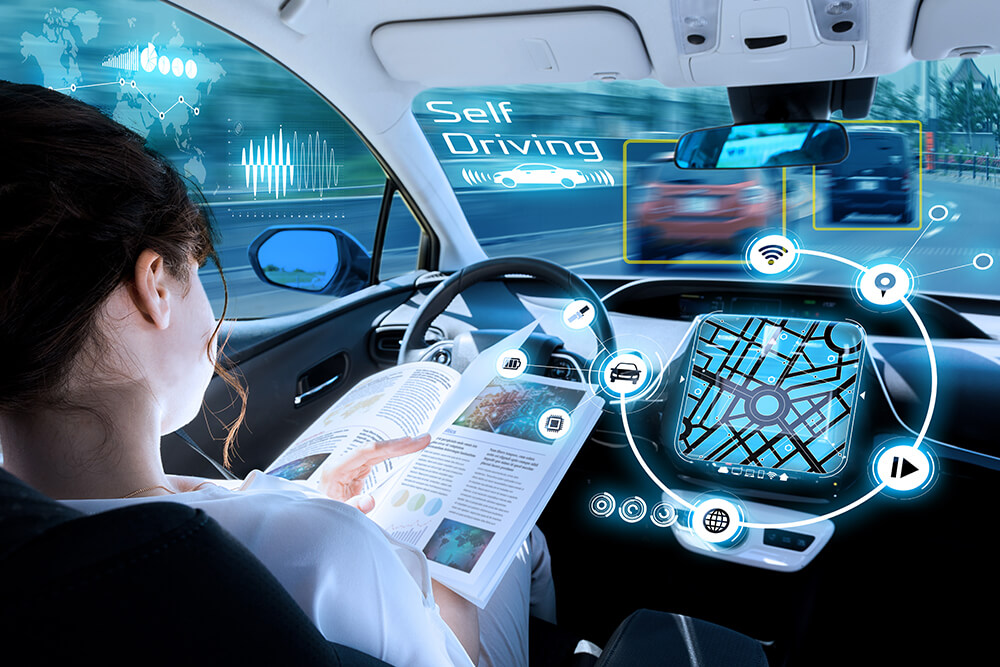
The Long Journey from Human Drivers to Intelligent Machines
For more than a century, driving has been a skill that people learned through practice, experience, and attention. Every day, millions of drivers make countless decisions while traveling on roads. They watch traffic lights, avoid obstacles, judge distances, change lanes, and react to unexpected situations.
Most people never think about how complex driving really is.
A driver must constantly observe the surroundings, predict what other vehicles might do, and make decisions within seconds. Even a short trip requires hundreds of small actions and judgments.
For many years, transportation depended entirely on human ability. Cars became faster, safer, and more comfortable, but one thing remained unchanged. A person still had to sit behind the steering wheel and control the vehicle.
Engineers and researchers began wondering whether machines could eventually take over this responsibility.
At first, the idea sounded impossible. Roads are unpredictable places filled with cars, motorcycles, bicycles, pedestrians, animals, construction zones, weather changes, and countless other variables. Teaching a machine to handle all these situations appeared to be an enormous challenge.
Yet advances in computing power, sensors, cameras, Artificial Intelligence, and mapping technology gradually brought the idea closer to reality.
The concept became known as autonomous driving.
An autonomous vehicle is a car, truck, bus, delivery robot, or other vehicle that can navigate and operate with little or no human involvement. Instead of relying on a human driver to make decisions, the vehicle uses software, sensors, and AI systems to understand its surroundings and determine the safest course of action.
The dream of self-driving vehicles gained momentum during the early twenty-first century as technology companies, automobile manufacturers, and research institutions invested heavily in the field.
What started as experimental prototypes slowly evolved into vehicles capable of driving on public roads. Today, autonomous technology is already being tested and used in various parts of the world.
The goal is not simply to create cars that drive themselves. The larger vision involves making transportation safer, more efficient, more accessible, and more convenient for everyone.
How Self-Driving Vehicles See and Understand the Road
When people drive, they depend mainly on their eyes, ears, and experience. A self-driving vehicle must achieve something similar using technology.
Modern autonomous vehicles are equipped with a wide range of sensors that constantly monitor the environment around them.
Cameras capture visual information much like human eyes. They identify traffic lights, road signs, pedestrians, vehicles, lane markings, and other important objects. Some vehicles use multiple cameras positioned around the entire vehicle to provide a complete view of the surroundings.
Radar systems help measure the distance and speed of nearby objects. These systems work effectively even during rain, fog, or darkness when visibility may be limited.
Many autonomous vehicles also use LiDAR technology. LiDAR sends laser pulses into the environment and measures how long they take to return. This allows the vehicle to create highly detailed three-dimensional maps of the surrounding area.
Together, these technologies generate enormous amounts of information every second.
The vehicle’s computer processes this data using Artificial Intelligence and machine learning systems. The AI identifies objects, predicts their movements, and determines how the vehicle should respond.
Imagine a child suddenly running toward a road while a cyclist approaches from behind and another vehicle prepares to change lanes. A human driver must evaluate all these factors instantly. Autonomous vehicles attempt to perform the same analysis using advanced software.
The system continuously asks questions.
Is the object ahead a pedestrian or a bicycle?
Will the pedestrian cross the road?
How fast is the approaching vehicle?
Should the car slow down, stop, or change lanes?
Thousands of calculations take place every second.
High-definition digital maps provide additional support. These maps contain detailed information about roads, intersections, speed limits, lane configurations, and traffic patterns.
Artificial Intelligence acts as the decision-making engine behind the entire process. Through extensive training using millions of miles of driving data, AI systems learn to recognize patterns and respond appropriately to different situations.
Engineers also use simulation environments where autonomous vehicles can practice driving in virtual worlds. These simulations allow systems to experience rare and dangerous scenarios without putting people at risk.
Although autonomous driving technology has made remarkable progress, creating a vehicle that can safely handle every possible road situation remains one of the most difficult engineering challenges ever attempted.
How Autonomous Vehicles Could Change Daily Life
The impact of autonomous vehicles may extend far beyond simply removing the driver from the vehicle.
One of the most important potential benefits is road safety.
Human error contributes to many traffic accidents worldwide. Drivers become distracted, tired, impatient, or impaired. They may overlook hazards, misjudge distances, or react too slowly during emergencies.
Autonomous vehicles do not become tired, fall asleep, send text messages, or lose concentration. If the technology reaches sufficient reliability, it could significantly reduce accidents and save countless lives.
Transportation accessibility may improve as well.
Many elderly individuals, people with disabilities, and others who cannot drive independently often depend on family members or public transportation. Self-driving vehicles could provide greater mobility and independence for these groups.
Imagine an elderly person scheduling a vehicle through a mobile app and traveling safely without needing assistance from others. Such capabilities could dramatically improve quality of life for millions of people.
Commuting may also change.
Many people spend hours each week driving through traffic. Autonomous vehicles could allow passengers to use travel time more productively by working, reading, studying, or relaxing while the vehicle handles navigation.
Logistics and delivery services are likely to experience major changes too.
Autonomous trucks may transport goods across long distances with greater efficiency. Delivery robots and self-driving vans could help companies move products faster while reducing operating costs.
Public transportation systems may become smarter and more flexible. Autonomous buses and shuttles could operate on demand, serving areas that currently lack reliable transportation options.
Cities themselves could evolve.
Parking requirements may decrease if autonomous vehicles spend less time sitting idle. Traffic flow could improve as intelligent vehicles communicate with one another and coordinate movements more efficiently.
Fuel consumption and emissions may also decline through smoother driving patterns, optimized routes, and integration with electric vehicle technology.
Agriculture, mining, construction, and industrial operations are already benefiting from autonomous machinery. Self-driving tractors, mining trucks, and specialized equipment can perform tasks with remarkable precision.
As adoption increases, autonomous technology may become part of nearly every transportation sector, from personal vehicles and taxis to freight networks and public transit systems.
The Challenges, Risks, and Road Ahead
Despite the excitement surrounding autonomous vehicles, significant challenges remain before widespread adoption becomes a reality.
Safety remains the most important concern.
Human drivers encounter countless unpredictable situations every day. Road construction, severe weather, unusual vehicle behavior, emergency responders, and unexpected obstacles can create highly complex scenarios.
Autonomous systems must demonstrate that they can handle these situations consistently and safely before earning public trust.
Weather continues to be a major challenge.
Heavy rain, snow, fog, dust storms, and poor road markings can interfere with sensors and reduce the quality of data available to the vehicle. Engineers are continuously working to improve performance under difficult conditions.
Legal and regulatory questions also need answers.
If a self-driving vehicle is involved in an accident, who is responsible? Is it the owner, the manufacturer, the software developer, or another party? Governments around the world are developing regulations to address these complex issues.
Cybersecurity is another critical area.
Modern autonomous vehicles rely heavily on software, connectivity, and digital communication. Protecting these systems from hacking and malicious attacks is essential for public safety.
Employment concerns are frequently discussed as well.
Professional drivers work in industries such as trucking, taxi services, ride-sharing, and delivery operations. As autonomous technology advances, some job roles may change significantly. At the same time, new opportunities are likely to emerge in software development, vehicle maintenance, fleet management, cybersecurity, and transportation technology.
Public acceptance will also play a major role in adoption.
People must feel comfortable trusting a machine with their safety. Building that trust will require years of testing, transparency, and proven reliability.
The future of autonomous vehicles will probably arrive gradually rather than all at once.
Many vehicles already include features such as adaptive cruise control, lane-keeping assistance, automatic parking, and collision avoidance systems. These technologies represent early steps toward greater autonomy.
Over time, vehicles are expected to become increasingly capable, eventually handling more driving situations with minimal human involvement.
The transformation could be as significant as the invention of the automobile itself. Roads may become safer, transportation may become more accessible, and logistics networks may operate with unprecedented efficiency.
The steering wheel may not disappear overnight, but the era of intelligent vehicles is steadily approaching. Autonomous vehicles represent one of the most ambitious technological projects of the modern age, and their success could reshape how people travel, work, and move goods across the world for generations to come.