The Dream of Controlling Machines with Thought Alone
For most of human history, people have interacted with technology through physical actions. We use our hands to type on keyboards, tap smartphone screens, press buttons, turn steering wheels, and operate machines.
Every command given to a computer, vehicle, or device usually passes through some form of physical movement.
But what if technology could respond directly to human thoughts?
What if a person could move a computer cursor, control a robotic arm, operate a wheelchair, or type a message simply by thinking about it?
For decades, these ideas belonged mostly to science fiction. Movies and novels often imagined futures where humans could communicate with machines using only their minds.
Scientists, however, saw these ideas as more than fantasy.
The human brain is one of the most remarkable systems ever known. It contains billions of nerve cells called neurons that constantly communicate using tiny electrical signals. Every thought, memory, movement, emotion, and decision involves complex patterns of neural activity.
Researchers began wondering whether these signals could be detected, interpreted, and translated into commands for machines.
This question led to the development of Brain-Computer Interfaces, commonly known as BCIs.
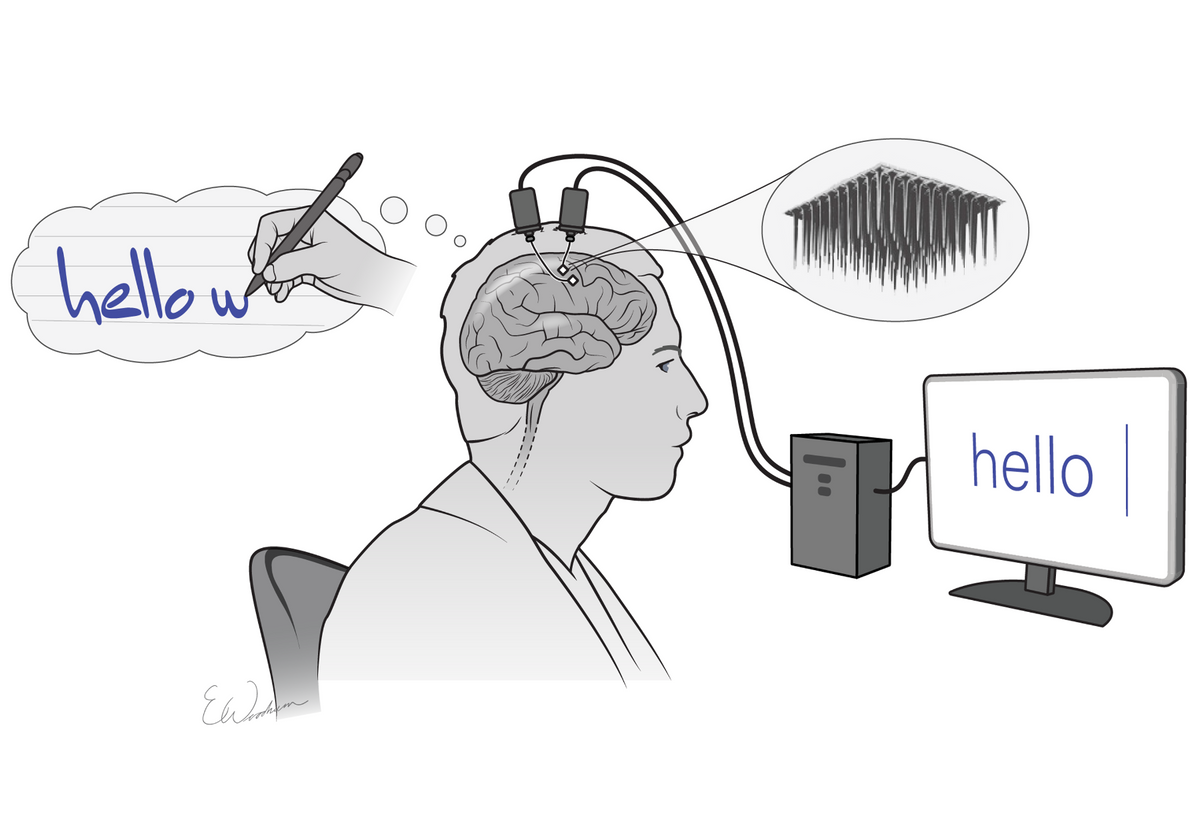
A Brain-Computer Interface is a technology that creates a direct communication pathway between the brain and an external device. Instead of relying on muscles and physical movement, BCIs use brain activity itself to control computers, software, robotic systems, and other technologies.
The concept sounds futuristic, but it is already becoming reality.
Scientists have successfully helped individuals with severe paralysis communicate using brain signals. Some people have used BCIs to move robotic limbs, operate computer systems, and perform tasks that were once impossible due to physical disabilities.
What makes BCIs so exciting is that they represent a completely new way for humans to interact with technology. Just as keyboards, touchscreens, and voice assistants changed computing in previous generations, brain-computer interfaces may eventually create an entirely new form of communication between people and machines.
The journey is still in its early stages, but the possibilities are capturing the attention of researchers, doctors, engineers, and technology companies around the world.
How Brain-Computer Interfaces Read Human Thoughts
To understand BCIs, it helps to first understand how the brain communicates.
Every time a person moves a hand, remembers a name, recognizes a face, or imagines an action, groups of neurons generate electrical activity. These signals travel throughout the brain, carrying information between different regions.
Although the brain is incredibly complex, many of these electrical patterns can be measured.
Some Brain-Computer Interfaces use sensors placed on the scalp. These devices detect electrical activity from outside the head without requiring surgery. Such systems are generally safer and easier to use, though they often provide less detailed information.
Other BCIs involve small implanted devices placed inside or near specific areas of the brain. These implants can capture signals with much greater precision, allowing researchers to interpret intentions more accurately.
Once brain signals are collected, sophisticated software analyzes them.
Artificial Intelligence plays a major role in this process. AI systems learn to recognize patterns associated with specific thoughts or intentions. For example, if a person repeatedly imagines moving a cursor to the left, the AI gradually learns to identify the corresponding brain activity.
Over time, the system becomes better at translating thoughts into actions.
Imagine a person who cannot move their arms due to paralysis. Through a Brain-Computer Interface, the individual may think about moving a robotic arm. The BCI captures the brain signals, interprets the intention, and sends commands to the robotic device.
The movement occurs without any physical muscle activity.
Researchers have demonstrated similar systems for typing text, controlling wheelchairs, operating computers, and even playing simple games.
The process may seem almost magical, but it relies on advanced neuroscience, engineering, computer science, and Artificial Intelligence working together.
Modern BCIs are becoming increasingly sophisticated. Improvements in sensors, machine learning algorithms, wireless communication, and computing power are helping researchers decode brain activity more accurately than ever before.
Many systems can now adapt to individual users, learning their unique neural patterns and improving performance with continued use.
Although the technology remains challenging, progress over the past decade has been remarkable. Tasks that once required large research laboratories can now be performed using increasingly compact and practical systems.
How BCIs Could Transform Healthcare and Daily Life
One of the most important applications of Brain-Computer Interfaces lies in healthcare.
Millions of people around the world live with conditions that affect movement, communication, or physical independence. For many of these individuals, BCIs could provide life-changing assistance.
People with paralysis may eventually regain the ability to interact with computers, communicate with loved ones, and control assistive devices through thought alone.
Imagine a person who has lost the ability to speak because of a neurological condition. A Brain-Computer Interface could potentially detect intended words and convert them into text or synthesized speech.
For someone who cannot move their limbs, a BCI-controlled robotic arm may restore the ability to perform everyday tasks such as eating, drinking, or handling objects.
Researchers are also exploring ways to use BCIs in rehabilitation.
After strokes, spinal cord injuries, or traumatic brain injuries, patients often require extensive therapy. Brain-computer systems may help retrain neural pathways and improve recovery outcomes.
The technology could eventually support advanced prosthetic limbs as well.
Traditional prosthetics often rely on muscle signals or mechanical controls. Future BCIs may allow artificial limbs to respond directly to the user’s intentions, creating movements that feel more natural and intuitive.
Beyond healthcare, Brain-Computer Interfaces may influence many aspects of daily life.
Computers could become easier to control without keyboards, mice, or touchscreens. People might navigate digital environments using thought-based commands. Virtual reality and augmented reality systems could become more immersive and responsive.
Education may benefit from personalized learning systems that adapt to a student’s attention levels and cognitive engagement. Workplace tools could become more efficient as brain-based inputs supplement traditional interfaces.
Gaming and entertainment industries are also exploring the possibilities.
Imagine controlling a game character directly through thought or interacting with virtual worlds in ways that feel far more natural than current controllers allow.
Some researchers envision future BCIs that work alongside Artificial Intelligence assistants. Instead of typing requests, users might communicate with digital systems through more direct forms of interaction.
While many of these possibilities remain years away, ongoing advances continue to move the technology closer to practical everyday applications.
The Challenges, Ethics, and Future of Human-Machine Connection
Despite the excitement surrounding Brain-Computer Interfaces, significant challenges remain.
The human brain is extraordinarily complex.
Scientists still do not fully understand many aspects of how thoughts, memories, emotions, and consciousness work. Interpreting brain activity accurately remains one of the most difficult scientific problems ever attempted.
Current systems can often detect broad intentions, but understanding detailed thoughts is far more challenging.
Technical limitations also exist.
Brain signals are often weak and difficult to interpret. Noise from surrounding electrical activity can interfere with measurements. Researchers must constantly improve hardware and software to increase accuracy and reliability.
Implanted BCIs present additional challenges.
Surgical procedures carry risks, and implanted devices must remain safe and functional for many years. Engineers continue working on biocompatible materials, wireless communication systems, and long-lasting implants.
Privacy concerns represent another major issue.
Brain activity is among the most personal forms of information imaginable. As BCI technology advances, society will need clear rules regarding how neural data is collected, stored, shared, and protected.
Questions about security are equally important.
If computers can communicate directly with the brain, protecting these systems from unauthorized access becomes essential. Future regulations and safeguards will likely play a critical role in ensuring user safety.
Ethical debates are already emerging.
Should healthy individuals use BCIs to enhance memory or cognitive performance? Could brain interfaces create unfair advantages in education or employment? How should governments regulate technologies that interact directly with human neural activity?
These questions do not yet have simple answers.
Even with these challenges, investment and research continue to accelerate. Universities, medical institutions, technology companies, and governments are dedicating significant resources to advancing Brain-Computer Interface technology.
Many experts compare today’s BCIs to the early days of personal computers or the internet. The technology remains limited in many ways, yet its long-term potential is enormous.
The first generation of computers filled entire rooms before evolving into laptops and smartphones. Brain-computer interfaces may undergo a similar transformation as hardware becomes smaller, safer, faster, and more affordable.
The future could bring a world where people interact with technology in ways that feel almost seamless. Communication, healthcare, education, entertainment, and accessibility may all be transformed by direct connections between the human brain and digital systems.
Brain-Computer Interfaces are not simply another technological innovation. They represent a new frontier where neuroscience and computing meet. By creating direct links between minds and machines, BCIs may fundamentally change how humans communicate, learn, work, and interact with technology in the decades ahead.